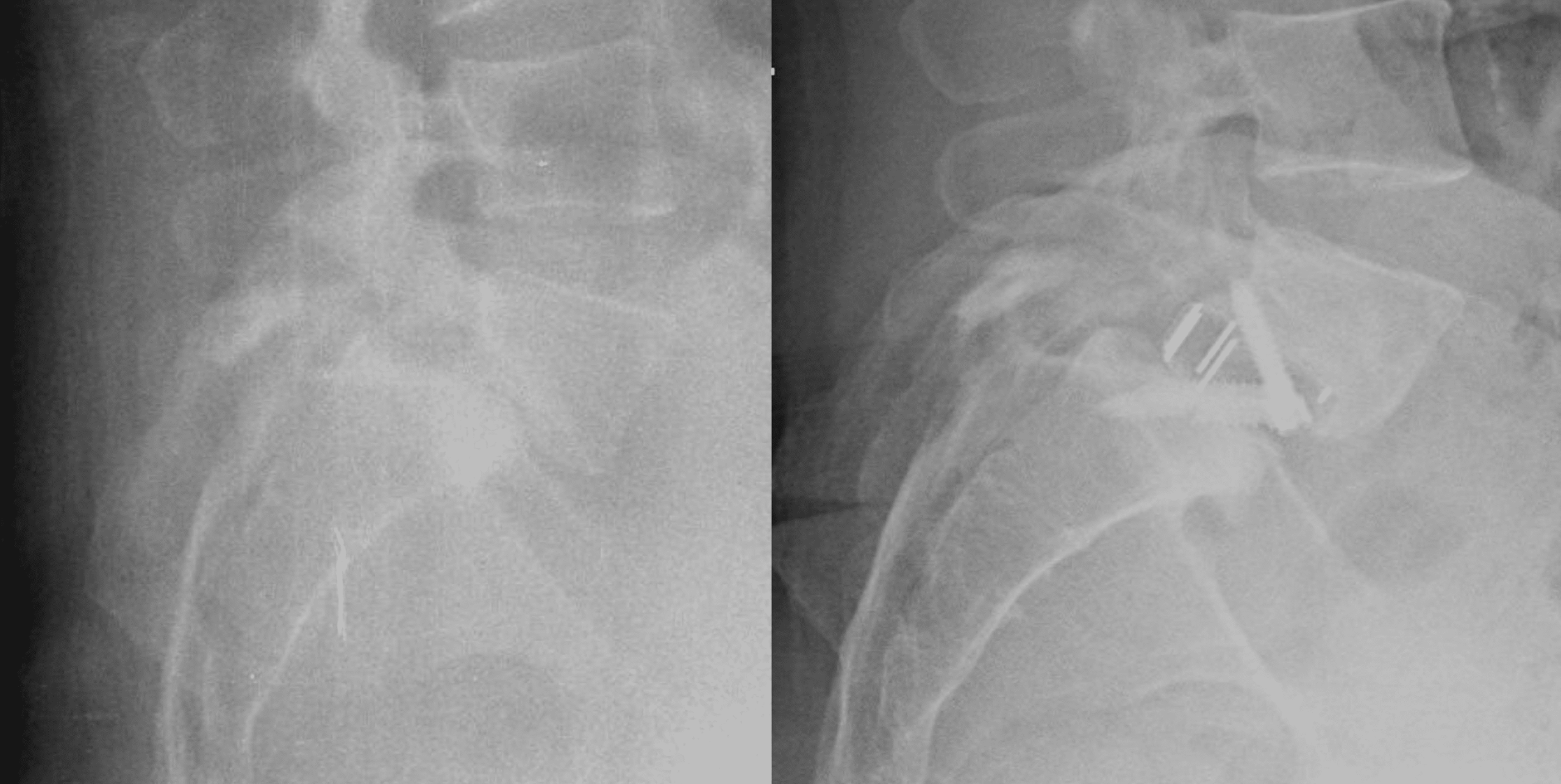
At FlyToSpine, we are always looking for the most advanced and effective options for spine care. Today we will explore a surgical approach for isthmic spondylolisthesis that is gaining ground due to its benefits for both the patient and the surgeon: pure anterior fusion or standalone ALIF.
An Overview of Isthmic Spondylolisthesis and the Evolution of Its Treatment
Isthmic spondylolisthesis is a condition in which a vertebra in the lumbar spine slips forward over the vertebra below. This occurs due to a fracture or defect in a small part of the bone called the isthmus or pars interarticularis, often the result of repetitive stress, common in athletes. Although it can be asymptomatic, when it causes persistent low back pain, leg pain, or neurological deficits that do not improve with conservative treatments, surgery becomes an option.
Historically, the treatment of spondylolisthesis has evolved significantly. From the first descriptions in the 18th century, through identification of the condition in the 20th century, surgical techniques have advanced remarkably. Initially, procedures such as isolated neural decompression were popular, but often resulted in greater slip progression due to lack of fusion. Posterolateral fusion (PLF) was described in the early 20th century and required long immobilizations as implants were not used to hold and stabilize the vertebrae.
The real breakthrough came with the development of spinal instrumentation, such as pedicle screws, devised in the 1970s by American surgeon Arthur Steffee and improved for deformity techniques in the 1980s by the French surgeons Yves Cotrel and Jean Duboisset. In the 1990s, interbody cages as we know them today appeared, enabling more stable and effective fusion techniques, such as TLIF (Transforaminal Lumbar Interbody Fusion), described by German surgeon Jürgen Harms. In the 21st century, spine surgery has embraced innovation, with minimally invasive approaches, advanced implants, and robotic-assisted systems that improve precision and recovery while reducing morbidity. It is in this context of constant improvement that standalone ALIF has reemerged strongly.
What is Standalone ALIF and Why is it Different?
Anterior Lumbar Interbody Fusion (ALIF) is a spinal fusion technique performed by accessing the spine through a small incision in the abdomen, at the front of the body. Unlike traditional posterior approaches, which require working through the back muscles, ALIF allows the surgeon to reach the spine without disturbing the posterior musculature and ligaments.


The term “standalone” means that fusion is achieved using only an implant (a cage or spacer) inserted into the disc space, often with screws or a plate integrated into the implant itself, without the need to add additional posterior instrumentation, such as pedicle screws in the back. This contrasts with ALIF-PSF (ALIF with posterior supplementary fixation), which combines the anterior approach with screws placed from the back with the intention of ensuring stability.
Advantages of Standalone ALIF: Benefits for Patient and Surgeon
The defense of standalone ALIF in the 21st century is based on solid medical and biomechanical justifications, which translate into tangible benefits:
For the Patient: Better Quality of Life and Recovery
- Less Invasive and Less Postoperative Pain: By avoiding dissection of the large back muscles, standalone ALIF reduces posterior muscle and ligament damage. This translates into less postoperative pain, potentially faster recovery, and absence of long-term muscle atrophy.
- Accelerated Recovery: Patients are usually walking within hours or the day after surgery and can return to normal activities in as little as six weeks, depending on the type of work. Hospital stay is 1 to 3 days, but discharge even before 24 hours is very common.
- Indirect Neural Decompression: The ALIF technique allows the insertion of a larger interbody cage into the disc space. This not only restores disc height but also indirectly increases space for nerve roots (foramen), relieving compression without the need for direct posterior decompression, which carries its own risks.
- Restoration of Natural Spinal Curvature: The ability to insert larger implants with controlled angulations from the front helps restore the natural curvature (lordosis) of the lumbar spine, which is very beneficial for stability and posture and, therefore, for the final result.
- Slip Correction: Although the anterior approach did not provide direct capability to perform reduction maneuvers of vertebral displacement, the mere distraction and increase of disc space already produces a one-grade reduction effect in most cases. Additionally, we have state-of-the-art implants that also allow adding another degree of reduction (about 8 mm) through a sliding drawer mechanism.
- Comparable Clinical Results: Recent studies, such as those by Toohey or Jesse, have demonstrated that standalone ALIF for Grade I isthmic spondylolisthesis offers significant improvements in patient-reported outcomes (pain and function) with success rates comparable to those obtained with ALIF supplemented with posterior fixation.
For the Surgeon: Technical Advantages and Efficiency
- Direct and Wide Access to the Disc: The anterior approach provides a clear view and unobstructed access to the disc space, allowing complete removal of the damaged disc and precise placement of large implants.
- Greater Construct Stability: The insertion of a large cage spanning a wide surface of the vertebral endplates, along with compression of the bone graft, contributes to inherent stability of the fusion construct.
- Reduced Surgical Times and Costs: By eliminating the need for a second posterior approach and associated instrumentation, standalone ALIF dramatically reduces surgery time and overall procedure costs. This is a benefit for both the healthcare system and the patient.
- Satisfactory Fusion Rates: For carefully selected patients, fusion rates with standalone ALIF are comparable to those of procedures with supplementary posterior fixation. For example, one study reported fusion rates of 82% for standalone ALIF versus 88% for ALIF-PSF at 12 months, with no significant differences.


Who is an Ideal Candidate for Standalone ALIF?
The key to the success of standalone ALIF lies in rigorous patient selection. This approach is especially promising for:
- Symptomatic isthmic spondylolisthesis Grades I and II: Patients with low-grade slips who experience persistent pain and do not respond to conservative treatments.
- Good Bone Quality: It is essential that patients have normal bone density to ensure implant integration and stability, although patients with bone defects such as hemangiomas or moderate osteoporosis can be previously treated with augmentation techniques (vertebroplasty).
- Adequate Sacral Slope: A sacral slope of less than 40° is a favorable factor. Very lordotic spines with a very inclined sacral plateau can transmit a lot of shear force to the implant screws, increasing the risk of breakage.
- Body Mass Index (BMI) <35: An elevated BMI can increase surgical complexity and risk of complications. Obese patients are not good candidates because the necessary abdominal approach would be too large to consider it advantageous compared to a posterior approach.


It must be each spine surgeon, based on their experience, who evaluates each case individually to determine if standalone ALIF is the most appropriate option, considering all anatomical and health factors of the patient.
Important Considerations
Although standalone ALIF offers multiple advantages, it is important to be aware of the potential risks associated with any spine surgery. The anterior approach, although avoiding the posterior musculature, involves working near important blood vessels and abdominal organs. Complications, although rare, may include vascular, visceral, or nerve injuries. Therefore, the experience of the surgical team, often including a vascular surgeon, is fundamental.
Conclusion: A Promising Future for Your Back
Anterior Lumbar Interbody Fusion (ALIF) in its standalone modality represents a significant advance in the treatment of low-grade isthmic spondylolisthesis. By combining a less invasive surgical technique with clinical and radiographic outcomes comparable to more extensive approaches, it offers a promising pathway to improve quality of life, accelerate recovery, and optimize results for appropriate patients.
If you suffer from persistent back pain due to isthmic spondylolisthesis, we encourage you to consult with a spine specialist. An accurate diagnosis and detailed discussion of all treatment options, including standalone ALIF, are the first step toward a healthier back and a pain-free life.
If you would like a second opinion regarding your spine condition or treatment plan, please contact our team.